
The game has changed: AI content creation is now about scale
In July 2026, the AI image generation space sent a clear signal: the era of one-off prompting is over for professionals. Midjourney rolled out its '--repeat' parameter, and Adobe Firefly announced 'Batch Generate' for enterprise clients. Both features address the same, massive production bottleneck: how do you create not one, but thirty consistent, on-brand visuals for a content calendar without losing your mind?
These updates validate a problem that social media managers have faced for years. While fun for exploration, prompting an AI one image at a time is not a professional workflow. It doesn't scale. Consistency is a constant struggle, and the time saved on one image is lost tenfold when you need a full campaign.
The solution isn't a single feature like 'repeat' or a costly enterprise tool. It's a shift in thinking—from making individual posts to building a content engine. In MyUP.ai, you can build a permanent, repeatable workflow that connects your content plan to your brand identity and generates an entire month of visuals on demand. This isn't just batch creation; it's true content automation.
Step 1: Prepare your inputs (the fuel for your content engine)
Every content engine needs fuel. For this workflow, your fuel is a simple spreadsheet. Forget complex prompts for a moment and think about your content calendar. You likely plan your posts around themes, quotes, stats, or questions. This is exactly what we'll use.
Create a new spreadsheet and save it as a CSV file. Set up columns for the dynamic parts of your posts. For a month of motivational quotes, it might look like this:
- Column A: `quote_text`
- Column B: `author_name`
- Column C: `visual_concept` (e.g., 'minimalist abstract shape', 'serene landscape', 'geometric pattern')
Fill in 30 rows, one for each day's post. This simple document is the blueprint for your entire month's visual content. It's structured, predictable, and ready to be fed into an automation workflow.
Step 2: Set your brand on autopilot with a MyUP Brandkit
The biggest challenge in batch-creating AI content is brand consistency. How do you ensure all 30 images use your exact brand colors, fonts, and logo placement? Trying to force this with text prompts alone is unreliable and frustrating.
This is where MyUP's Brandkit changes the game. Instead of describing your brand in a prompt, you define it once. In your MyUP account, create a Brandkit by:
- Uploading your logo files.
- Defining your primary and secondary brand colors.
- Specifying your brand fonts for headings and body text.
Once saved, this Brandkit acts as a permanent set of instructions. Any workflow you connect it to will automatically apply these visual rules, ensuring every single output—from the first to the thirtieth—is perfectly on-brand. You solve the consistency problem before you even start generating.
Step 3: Build your one-time batch generation workflow
With your inputs prepared and your Brandkit ready, it's time to build the engine itself. This is a one-time setup in the MyUP Workflow Builder that you can reuse every month.
Here’s the basic structure:
- Start with Data: Create a new workflow and add a 'Data Input' node. Upload the CSV file you created in Step 1. MyUP will recognize the columns and rows.
- Choose a Template: Add a 'Template' node. This is the visual foundation for your posts. For a clean, text-heavy series of quotes, a design like the Bold Editorial Grid Poster is an ideal starting point. It provides a strong layout that your content will populate.
- Map Your Content: Connect the 'Data Input' node to the 'Template' node. You'll see fields for the text and image elements in the template. Simply map your CSV columns to these fields. For instance, connect your `quote_text` column to the headline field and your `author_name` column to the sub-headline field.
- Apply Your Brand: Finally, connect your saved Brandkit to the workflow. This single connection instructs MyUP to apply your logo, fonts, and colors to every single graphic it generates.
To get started instantly with a pre-built structure for this exact task, you can use the workflow for the Bold Editorial Grid Poster directly in MyUP.
Workflow code: #myup-n0bi-2wzk
Bold Editorial Grid Poster
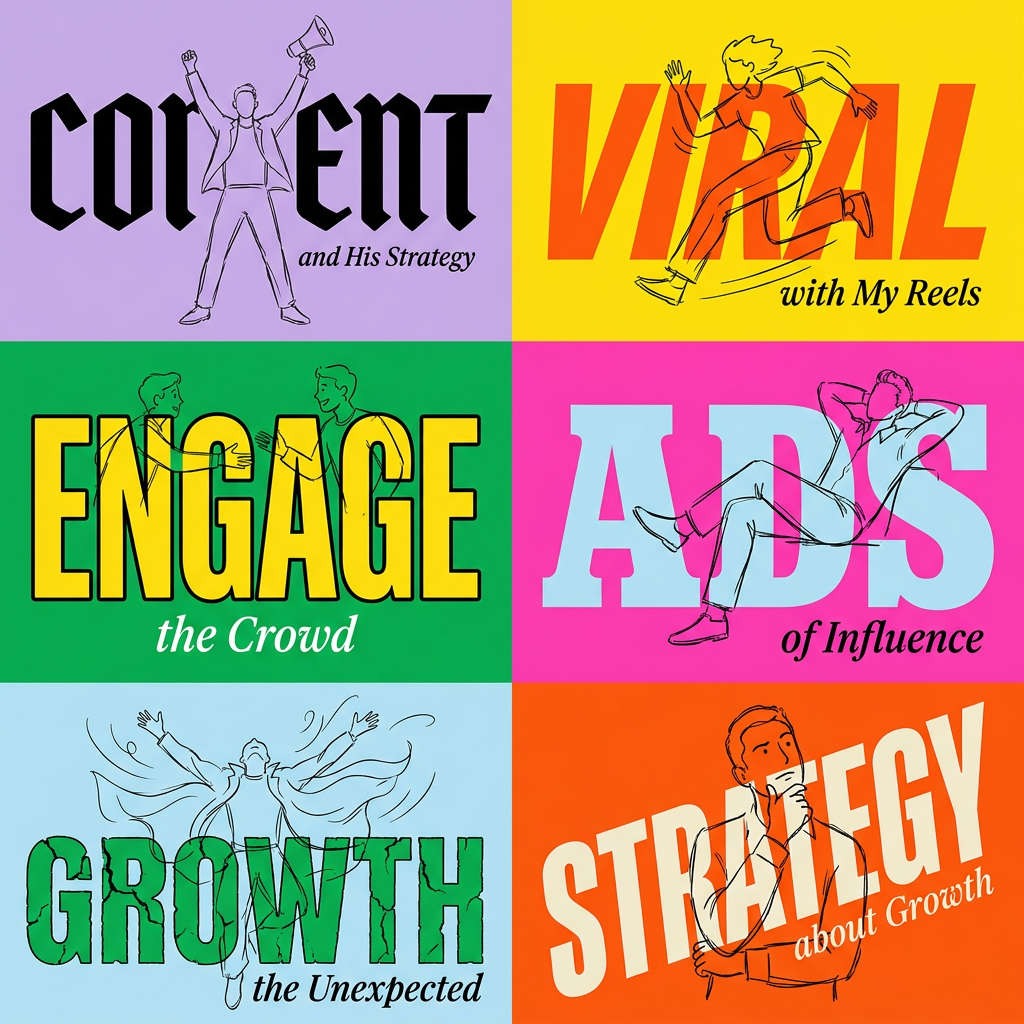
Create striking 2x3 editorial posters with six seamless, flat-color square cards in a perfect 4:5 grid. There are absolutely no gaps between the blocks, giving your content a bold, high-contrast magazine layout. It looks incredibly clean on any social feed.
Regenerate using your own assets.
Step 4: Execute, review, and export your entire month's calendar
This is the moment of truth. Click 'Run Workflow'. MyUP will now execute your instructions, iterating through every row of your CSV file. It will generate a unique visual for each row, applying the template structure, your specific content, and your brand identity automatically.
In a few minutes, you'll see a grid of 30 distinct, on-brand social media visuals ready for review. This is where the principle of 'human control' comes in. MyUP handles the heavy lifting of production, but you are the final validator. You can scan the entire batch, discard any options that don't quite fit, or even tweak a specific input in your CSV and re-run that single item. Once you're satisfied, you can export the entire collection and schedule your content calendar.
What used to be hours of repetitive design work or inconsistent AI prompting is now a streamlined, 30-minute process from start to finish.
Adapting your engine for different content types
The power of a workflow is its reusability. The same engine you built for quotes can be adapted for virtually any other recurring content need just by swapping the template and the input data. You don't need to start from scratch.
- Hiring Announcements: Need to post about new roles? Use a CSV with `job_title`, `department`, and `location` columns, and plug it into the Modern Hiring Poster template. Workflow code: #myup-eiob-7tbc
- Product Features: Showcasing new arrivals? A CSV with `product_name` and `feature_description` can feed into a template like the Brand Clothes Post to generate visuals for your e-commerce brand. Workflow code: #myup-3sro-edbt
- Event Reminders: Simple date-based posts or calendar highlights can be automated, too. A simple template like Textured Paper Calendar Close-Up can be driven by a sheet of dates and event names. Workflow code: #myup-hcix-fsva
By building a library of these simple workflows, you move from being a content creator to a content system designer, saving dozens of hours each month.
Stop prompting, start building
The future of AI-powered content creation isn't about finding the perfect magic prompt. It's about building efficient, repeatable systems that handle the production work for you. Manually creating or prompting every single social media post is a production bottleneck that no longer needs to exist.
With a single workflow in MyUP.ai, you can set up a content engine that saves you hours of work every single month. You define the logic once, feed it new data, and let the platform generate a month's worth of on-brand visuals while you focus on strategy. It's time to build your first engine.